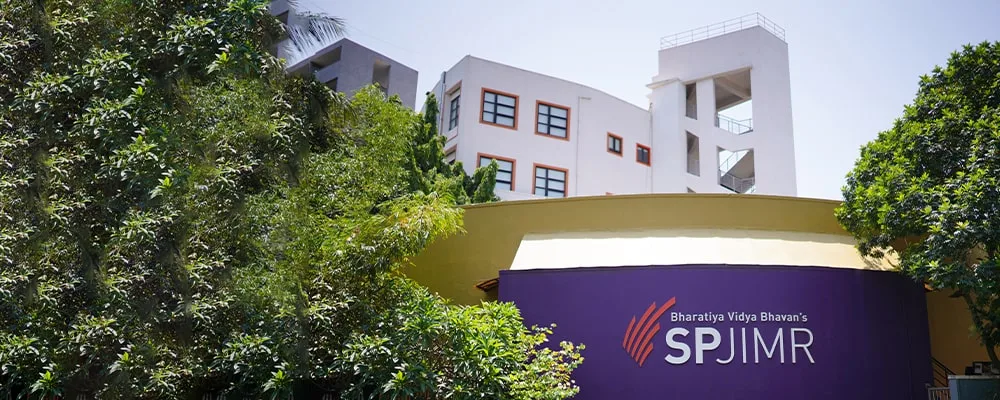

The four SPJIMR programmes compared
In one line: The four programmes differ in fee, duration, work-experience requirement and start date — so the first question is not whether to apply to SPJIMR, but which programme you are eligible for.
Almost everything written about SPJIMR treats it as a single product. It is not. It runs four full-time postgraduate programmes with different fees, different eligibility, different start dates and — as the rankings section below shows — different global rankings. Start here, because picking the wrong programme is the most expensive mistake available.
| Programme | Duration | Work experience | Fee | Starts |
|---|---|---|---|---|
| PGDM | 2 years | 0–5 years | ₹24,86,000 | June 2027 |
| PGDM (Business Management) | 2 years | 0–5 years | ₹24,86,000 | June 2027 |
| PGPM | 18 months | Minimum 3 years | ₹22.66 lakh | December 2026 |
| Global Management Programme | 12–24 months | Not mandatory | ₹28–97 lakh full programme | June 2026 |
Official source: SPJIMR Explore Programmes listing and each programme’s fees and admissions pages, captured 3 August 2026. Duration, work experience, fee and start month change rarely; application status changes constantly — see the Application timeline and phases section below for the current, dated status of each programme rather than a snapshot here.
Work experience is the real sorting mechanism. PGDM and PGDM (BM) take 0–5 years, so a fresher and a candidate with four years compete in the same pool. PGPM requires a minimum of three years at the time the programme commences — a fresher simply cannot apply. GMP requires none. Any single sentence about “SPJIMR eligibility” is therefore wrong for at least two of the four programmes.
PGDM versus PGDM (BM) is the closest call, and it is not about money or salary. The two cost exactly the same, start the same month, take the same experience band, and — because SPJIMR runs a combined placement process for them — report an identical median. SPJIMR describes PGDM (BM) as “built on identical pillars as the current PGDM programme” with “unique flexibility to choose a preferred mix of courses to align with their career goals.” So the difference is curriculum structure: PGDM asks you to commit to one of four specialisations at application, while PGDM (BM) is the flexible-mix route. PGDM (BM) also admits only 120 participants.
For a 2027-intake reader, PGDM and PGDM (BM) are the live options even though both show as closed today — their applications open around mid-September and close end of November, for interviews in January and February 2027. PGPM's December 2026 start makes it a different decision on a different clock.
SPJIMR fees 2026-27 by programme
In one line: PGDM and PGDM (BM) both cost ₹24,86,000; PGPM is ₹22.66 lakh but excludes mess charges; GMP ranges from ₹28 lakh to ₹97 lakh depending on partner school.
SPJIMR quotes one programme fee per course rather than an annual, category-wise structure — so there is no per-year table and nothing here should be multiplied. Each figure is labelled by SPJIMR as indicative and subject to revision.
| Programme | Fee | Includes | Excludes |
|---|---|---|---|
| PGDM | ₹24,86,000 Indian ₹34,77,500 international | Tuition and basic hostel/accommodation | Global Fast Track and International Exchange |
| PGDM (BM) | ₹24,86,000 Indian | Tuition and basic hostel/accommodation | Global Fast Track and International Exchange |
| PGPM | ₹22.66 lakh | Tuition and basic hostel/accommodation | Mess charges, travel and boarding during internships, International Immersion and International Exchange |
| GMP | ₹9,50,000 plus taxes for six months at SPJIMR Mumbai | The SPJIMR component only | Partner-school costs — SPJIMR gives a full-programme ballpark of ₹28 lakh to ₹97 lakh |
Official source: the fees and scholarships page for each programme on spjimr.org, captured 3 August 2026. Application processing fee for PGDM is ₹2,000, also stated as subject to revision.
PGPM is not really ₹2.2 lakh cheaper than PGDM. That is the headline gap, but PGPM is the only one of the four whose fee explicitly excludes mess charges, along with travel and boarding during internships — costs the PGDM figure already absorbs. Before treating PGPM as the economical option, get the mess figure from SPJIMR and add it back. The comparison is close enough that this single exclusion can reverse it.
GMP must never be quoted as a single number. The ₹9,50,000 is six months in Mumbai. SPJIMR’s own stated range for the complete programme, including the international partner school, is ₹28 lakh to ₹97 lakh — a 3.5× spread that depends entirely on which partner institution you go to. Any site listing “GMP fee: ₹9.5 lakh” is quoting a fraction of the cost as though it were the total.
What no fee figure here covers. The Global Fast Track and International Exchange components are optional on PGDM and PGDM (BM), and SPJIMR states plainly that their expenses are outside the quoted fee. If an international component is part of why you are choosing SPJIMR, the published fee is not your budget. Ask for the component cost in writing before you commit.
To see what any of these costs to service as a loan, our fee EMI calculator takes a principal, rate and tenure and returns the monthly instalment — useful when the gap between ₹22.66 lakh and ₹24.86 lakh needs turning into a monthly number.
Eligibility by programme
In one line: A 50% bachelor’s degree covers PGDM, PGDM (BM) and PGPM; GMP requires 55%. The work-experience rule is what actually separates them.
SPJIMR publishes eligibility per programme. The academic bar is broadly consistent; the experience requirement is not.
| Requirement | PGDM and PGDM (BM) | PGPM | GMP |
|---|---|---|---|
| Degree | Bachelor’s with at least 50% or equivalent CGPA, any discipline, recognised university; minimum three years after 10+2 | Bachelor’s with at least 50% or equivalent CGPA, any discipline | Graduation in any stream with 55% and above |
| Work experience | Not mandatory — freshers and up to five years may apply | Minimum three years of relevant experience at the time the programme commences | Not mandatory — freshers and experienced may apply |
| Tests accepted | CAT and GMAT | CAT and GMAT; GMAT Focus Edition accepted for Batch 23 | GRE, GMAT, CAT, XAT or NMAT |
| GMAT delivery mode | In-person test centres only | Online, offline or Focus, submitted via the GMAC portal | Valid score; English proficiency needed for US/Canada schools and a German visa |
| Score-report code | — | PGPM programme code 6DQ-MJ-12 | GMAT 6DQ-MJ-52 · GRE 5020 · TOEFL C862 |
Official sources: SPJIMR domestic eligibility criteria document for PGDM and for PGDM (BM); the PGPM and GMP admissions pages on spjimr.org. Read 3 August 2026.
The GMAT delivery rule contradicts itself across programmes, and it disqualifies people quietly. The PGDM criteria state that “only scores for tests taken in-person (test centers) will be accepted for GMAT/GMAT focus edition.” PGPM, by contrast, explicitly accepts GMAT Online, Offline or Focus through the GMAC portal. A candidate holding an online GMAT is eligible for PGPM and ineligible for PGDM at the same institute. Check which score you actually hold before choosing a programme.
PGDM asks you to choose a specialisation at application. Applicants select from Finance, Information Management & Analytics, Marketing, and Operations & Supply Chain, stating two preferences. SPJIMR says this drives early focus, allows segmentation for recruiters and broadens the recruiter spectrum. It is unusual — most MBA applications do not ask for a specialisation commitment up front — and it means your work experience is assessed for relevance to the specialisation you picked, not in the abstract.
What does not count as work experience. SPJIMR excludes internships, training and project work that formed part of your curriculum; apprenticeships such as articleship required by professional courses; and any unpaid work. Proof is required in the form of offer letter, salary slips and experience letter. Candidates from CA and similar routes regularly overestimate their countable experience on this rule.
Final-year students may apply. They must produce a provisional certificate confirming they have appeared for all exams, and the available semester marks are used to compute the graduation percentage — which must still reach 50%. The degree itself must be submitted by 31 December of the admission year, and registration remains provisional until it is; failure to submit cancels the registration. Applicants with overseas degrees additionally need an AIU Equivalency Certificate.
On CGPA conversion, SPJIMR is specific: use your institution’s published conversion factor, and where none exists, multiply the CGPA by 10. A conversion certificate is required at verification if you are shortlisted.
CAT and GMAT qualifying scores
In one line: PGDM requires the 75th percentile in every section and the 85th overall — a strong overall percentile with one weak section does not qualify.
This is the section most aggregators get wrong, because they report the overall percentile and omit the sectional floor. SPJIMR requires both.
| Test | Section 1 | Section 2 | Section 3 | Overall |
|---|---|---|---|---|
| CAT | Verbal Ability & Reading Comprehension 75 | Data Interpretation & Logical Reasoning 75 | Quantitative Ability 75 | 85 |
| GMAT | Verbal 75 | Quantitative 75 | — | 85 |
| GMAT Focus Edition | Verbal 75 | Quantitative 75 | Data Insights 75 | 85 |
Official source: SPJIMR domestic eligibility criteria for PGDM. Percentiles are qualifying cut-offs, and SPJIMR notes it reserves the right to modify selection criteria. The cut-off structure is stable year to year; the exam year and the GMAT validity window belong to each admission cycle, so confirm the current cycle’s window when you apply.
Both bars must be cleared, not either. A candidate at the 92nd percentile overall with a 70th percentile in Quantitative Ability does not meet SPJIMR’s qualifying score, despite a headline number well above 85. Conversely a candidate at exactly 75 in all three sections still needs the composite to reach 85. If you are targeting SPJIMR, section balance matters more than at institutes that screen on the aggregate alone — and that should shape how you allocate preparation time.
Meeting the cut-off is necessary, not sufficient. SPJIMR states that applicants are shortlisted on their profiles and sorted into two groups — Profile-based and Profile-cum-Score-based. Beyond the entrance score, the factors are academic consistency across 10th, 12th and every year of graduation; the relevance of work experience to your chosen specialisation; and versatility and achievements. The 10th and 12th marks genuinely count here, which is unusual and catches out candidates who assume only graduation matters.
For international candidates SPJIMR describes the assessment as covering “intellectual readiness (academics) and also on emotional readiness”, the latter including work experience, extra-curricular activity and fit with the institute’s stated mission of value-based leadership.
Because both bars are percentile-based, the exam you sit matters less than how evenly you score across it. Our CAT guide and GMAT guide cover the pattern and sectional structure of each, which is the thing to plan around when an institute screens on section balance rather than the aggregate.
Application timeline and phases
In one line: PGDM applications open mid-September and close end of November, with interviews in January and February 2027; PGPM runs three separate phases.
The two clocks are different. PGDM and PGDM (BM) run one annual cycle for a June start. PGPM runs three phases for a December start.
| Stage | When |
|---|---|
| Applications open | Mid-September |
| Applications close | End of November |
| Interviews — Mumbai Phase 1, Kolkata | January 2027 |
| Interviews — Bengaluru, Delhi Phase 1, Delhi Phase 2, Mumbai Phase 2 | February 2027 |
| Programme starts | June 2027 |
Official source: SPJIMR PGDM admissions page, which labels this schedule “Tentative interview schedule (in-person) for 2027 intake”. Application processing fee ₹2,000.
What to actually do: mark your calendar for mid-September 2026, not today. On 3 August 2026, SPJIMR's own Explore Programmes page showed PGDM and PGDM (BM) as "Applications closed" for the programme starting June 2027. That reads as "closed" rather than "not yet open" only if you stop at the badge. SPJIMR's own admissions page separately labels its interview schedule "Tentative interview schedule (in-person) for 2027 intake", running January–February 2027 — dates that only make sense for a cycle still ahead of us, not one that has already run and closed. Put alongside SPJIMR's stated pattern that the application form "is available from September every year", the more consistent reading is that the badge means not yet open, and the window opens in mid-September 2026. Treat that as the expected date, not a guarantee — confirm SPJIMR's live badge on the day you plan to apply, since application status is the fastest-changing fact on this page.
| Stage | Phase I | Phase II | Final phase |
|---|---|---|---|
| Applying online opens | 1 April 2026 | 1 June 2026 | 1 August 2026 |
| Completed form due | 31 May 2026 | 31 July 2026 | 15 September 2026 |
| Admission offers | August | End of September | Mid-October onwards |
Official source: SPJIMR PGPM admissions page. Shortlisting and interviews run between June and October, with only shortlisted candidates notified by email. Final offers from mid-October onwards. Scores must be submitted by end of September; GMAT scores from 30 September 2021 to 30 September 2026 and CAT scores from 2023, 2024 and 2025 are accepted. Batch commences December 2026.
Read the PGPM banner carefully — this trips people up. SPJIMR’s PGPM page headline still shows the Phase II deadline of 31 July 2026, which has passed. But a Final phase opened on 1 August 2026 and runs to 15 September 2026, which is why the programme listing shows PGPM as open. A candidate reading only the banner would conclude they had missed the cycle when they have not.
Applying in a later phase does not disadvantage you. SPJIMR states explicitly: “Applicants can apply only once in any of the given admission phases. Applying in any phase does not impact your chances of securing an admission offer.” That is worth knowing, because the common assumption with rolling admissions is that early phases are easier. SPJIMR says otherwise — but you get one attempt, so apply when your application is actually ready.
SPJIMR also notes that admission and final offers go only to candidates who complete the interview process and submit all required documents including valid CAT or GMAT scores. An offer is not confirmed until verification is done.
Global Management Programme: the dual-degree route
In one line: GMP is 6 months at SPJIMR Mumbai plus 6 to 18 months abroad, ending in a GMP certificate from SPJIMR and an MS or MBA degree from the international partner school.
GMP is structurally unlike the other three programmes, and the ₹28 lakh to ₹97 lakh range makes sense only once you see why: it is not one qualification but two, delivered on two continents.
| Element | What SPJIMR publishes |
|---|---|
| Duration and split | 12–24 months full time: 6 months at SPJIMR Mumbai campus and 6 to 18 months at international partner schools in the USA, UK, Europe or Canada |
| Qualification | GMP certificate from SPJIMR and an MS or MBA degree from the international partner school, with dual alumni status |
| Cohorts | January and June every year |
| Curriculum | A mix of foundation and compulsory courses; language training in German and French; a prep-term of six certified courses from Harvard Business Publishing |
| US pathway | STEM designated programme in the USA, offering 3-year OPT |
| Scholarships | SPJIMR states special scholarships of up to 70% are available from international partner schools |
| Eligibility | Bachelor's degree in any stream with at least 55% or equivalent CGPA; freshers and experienced candidates may apply; valid CAT, GMAT, GRE, NMAT or XAT score; IELTS or TOEFL required by selective partner schools |
| Selection | Round I — interview with SPJIMR. Round II — interview by the international partner school. Both must be cleared. |
Official source: SPJIMR Global Management Programme brochure, December 2025 edition.
| Region | Partner schools named |
|---|---|
| USA | Brandeis International Business School · Stevens Institute of Technology, School of Systems & Enterprises · Robert H. Smith School of Business (University of Maryland) · USC Marshall School of Business · University of South Florida · University of Miami |
| Europe | ESB Business School · Nyenrode Business Universiteit · IESEG School of Management · EBS Universität |
| UK | Aston Business School |
| Canada | SFU Beedie School of Business (Simon Fraser University) |
Official source: SPJIMR Global Management Programme brochure, December 2025 edition, "International Partner Schools" page. The regional grouping matches the four geographies SPJIMR quotes salary ranges for — six US schools, four European, one UK, one Canadian — so the brochure's own structure and its own salary table agree with each other.
This list is why "GMP" is not one outcome. A GMP participant does not simply "go abroad" — they are admitted to one specific school on this list, in one specific country, and that school's own admissions team runs Round II. Six of the twelve are in the USA, which is also the widest salary band quoted ($85K–$120K); a candidate placed at the sole UK or Canada option is looking at a different market and a different range entirely. Ask which schools you are actually eligible for before treating the ₹28–97 lakh range as a single decision.
Why the fee is a range and not a number. The ₹9,50,000 plus taxes covers the six months in Mumbai. Everything after that is the partner school's own tuition, in its own currency, in its own country — which is why SPJIMR's stated ballpark for the whole programme spans ₹28 lakh to ₹97 lakh. The variable is not SPJIMR; it is which school you are admitted to and for how long. SPJIMR does say participants receive a special tuition rate at the partner school under its partnership, and separately that scholarships of up to 70% are available from those schools.
The second interview is the part people miss. Clearing SPJIMR's Round I does not secure a place. Round II is conducted by the international partner school, and the STEM designation, the OPT entitlement and the eventual degree all come from that school rather than from SPJIMR. A candidate should therefore evaluate the partner institutions as carefully as they evaluate SPJIMR — the foreign degree is the larger part of both the cost and the credential.
On the salary figures in the brochure, read the label. SPJIMR publishes these under Career Services Assistance as the range of average packages after internships, by geography: USA $85K–$120K, Europe €45K–€65K, UK £41K–£65K, Canada $55K–$65K. These are international outcomes attached to the partner-school phase, in foreign currency, and they are not comparable with the rupee CTC figures reported for PGDM, PGDM (BM) and PGPM. Do not convert them and set them side by side — different labour markets, different cost of living, different tax.
Two practical notes. The programme runs January and June cohorts, so it is the only SPJIMR programme with two annual entry points. And the German and French language training is a genuine signal about where the European partner schools sit — worth weighing if a non-English-speaking placement is not what you want.
SPJIMR placements by programme
In one line: PGDM and PGDM (BM) both report a ₹32.85 LPA median because they share one placement process; PGPM reports a 119% average increase on incoming pay instead.
SPJIMR publishes a median for its two PGDM programmes, which many business schools do not. Where median and average differ, the median is the better guide to what a typical graduate received.
| Programme and batch | Median CTC | Average CTC | Highest CTC |
|---|---|---|---|
| PGDM 2024-26 (final placements) | ₹32.85 LPA | ₹33.6 LPA | ₹75 LPA |
| PGDM (BM) 2024-26 (final placements) | ₹32.85 LPA | ₹34.05 LPA | ₹65 LPA |
| PGPM 2024-25 | not published | ₹24.40 LPA | ₹50 LPA |
Official source: SPJIMR placements page, captured 3 August 2026. PGPM additionally reports a 119% average increase over incoming pay.
The identical median is not a coincidence. SPJIMR runs a combined placement process for PGDM and PGDM (BM), so the two cohorts face the same recruiters in the same season. Their medians are the same figure; only the tails differ, with PGDM reaching a ₹75 LPA high against PGDM (BM)’s ₹65 LPA. Choosing between these two programmes on expected salary is choosing on noise.
PGPM’s ₹24.40 LPA is not a worse outcome — it is a different measurement. PGPM candidates arrive with a minimum of three years’ experience and are already earning, which is why SPJIMR reports a 119% average increase over incoming pay alongside the absolute figure. Comparing a mid-career candidate’s post-programme CTC against a fresher-inclusive cohort’s CTC tells you very little; the increase-on-incoming metric is the one that describes what the programme did for them.
The internship cycle shows where the roles are going. For the PGDM and PGDM (BM) Class of 2027 — the batch a 2027-intake reader will follow — SPJIMR reported a 361-member cohort receiving 425 internship offers from 81 companies, including 22 first-time recruiters. Investment Banking and Private Equity offers rose by over 100%, and Product Management roles by 56%. Around a third of participants were placed in Consulting, with roughly 24% in FMCG.
One statistical detail worth pausing on. In that internship cycle the average stipend was ₹1.66 lakh per month while the median was ₹1.71 lakh — the median sits above the average. That is the reverse of the usual pattern and it means a tail of lower stipends is pulling the mean down rather than a few large offers pulling it up. In plain terms, the typical intern did slightly better than the headline average suggests. The top 50% averaged ₹2 lakh per month, the top 20% ₹2.16 lakh, and the highest stipend reached ₹2.5 lakh.
Rankings and accreditation
In one line: The FT Global MBA 2026 rank of #74 belongs to PGPM and the FT Masters in Management 2025 rank of #35 belongs to PGDM — they are not interchangeable.
SPJIMR holds two Financial Times rankings, and they describe different programmes. This is the most commonly misreported fact about the institute.
| Ranking | Result | Programme it describes |
|---|---|---|
| FT Global MBA 2026 | #74 in the world | PGPM — SPJIMR states it is ranked “for its Post Graduate Programme in Management (PGPM) for experienced professionals”, and that FT noted SPJIMR as the highest new entrant in that year’s MBA table |
| FT Masters in Management 2025 | #35 in the world, #3 in India | PGDM — SPJIMR states a global rank of #3 in the Careers Service category for its two-year PGDM, and #1 among Indian business schools for PGDM on alumni network, value for money, and ESG and net zero teaching |
Official source: SPJIMR rankings page, captured 3 August 2026, reporting the Financial Times Global MBA 2026 and FT Masters in Management 2025 rankings.
The same rankings page reports two further placings, at national rather than global level.
| Ranking | What SPJIMR states |
|---|---|
| Fortune India Best B-Schools 2025 | SPJIMR's own badge for this specific ranking reads "#1 Private B-school, #5 all-India". |
| India Today Group MDRA Best Business Schools Survey | SPJIMR describes this survey as evaluating "academic rigour, faculty expertise, industry engagement and technological innovation"; the page did not show a distinct numeric rank separate from the Fortune India figures above at the point captured. |
Official source: SPJIMR rankings page (spjimr.org/about-us/rankings/), captured 3 August 2026.
We are keeping the India Today and Fortune India figures separate rather than merging them, on purpose. SPJIMR's own page places an "All India Private B-school #1" and "All India Rank #5" pair of badges directly beneath its India Today description, and a differently labelled "#1 Private B-school, #5 all-India" graphic against the Fortune India heading immediately below that. The two could be the same result reported twice, or two separate surveys that happen to agree — the page does not say. Rather than pick one reading to sound tidy, we attribute the confirmed "#1 Private B-school, #5 all-India" wording to the source it is explicitly badged against, Fortune India Best B-Schools 2025, and describe the India Today survey on its own terms without asserting it produced the identical numbers.
SPJIMR reports three further recognitions on its About page, and they are worth separating by who awarded them:
| Awarding body | What SPJIMR states |
|---|---|
| Financial Times Global Rankings 2024 | Recognised SPJIMR as India’s #1 business school |
| Business Today | One of the country’s top five business schools |
| Positive Impact Rating (PIR), a Swiss association | A ‘pioneering’ school with the highest ‘Level 5’ rating for its societal impact and sustainability achievements |
Official source: SPJIMR About page, captured 3 August 2026. These are SPJIMR’s own reports of third-party results; the awarding body is named in each case so the claim can be traced to its origin rather than to us.
The Positive Impact Rating is the least familiar of these and the most distinctive. PIR is a Swiss association that rates business schools on societal impact rather than salary or selectivity, scored by the schools’ own students. A Level 5 ‘pioneering’ rating is its highest band. Whether that matters to you depends entirely on what you want from a business school — it says nothing about placement outcomes, and it is not comparable with an FT position.
Note the date on the FT “India’s #1” recognition: 2024. The FT rankings above are from the 2026 Global MBA and 2025 Masters in Management tables, so the three FT-related claims on SPJIMR’s site come from three different years. Read each with its year attached rather than as one standing position.
On institutional lineage, SPJIMR states it was established in 1981 in Mumbai and is a constituent of Bharatiya Vidya Bhavan, an educational trust established in 1938.
Why this distinction matters practically. If you are applying to PGDM as a fresher or with two years of experience, the #74 FT Global MBA position is not your programme’s ranking — it belongs to the programme you are not eligible for. The relevant figure for PGDM is the FT MiM #35 global and #3 India position. Sites that print “SPJIMR — ranked #74 globally” beside PGDM fees are attaching one programme’s result to another.
SPJIMR describes the FT MBA methodology as assessing schools on salary outcomes, value for money, career progression, gender diversity, internationalisation, research and commitment to sustainability.
On accreditation, separate the fact from the claim. The verifiable facts are that SPJIMR is a category-I management institute under AICTE, accredited by AACSB, AMBA (UK) and EQUIS (EFMD). Those three together are what is termed ‘Triple Crown’.
SPJIMR additionally states that it is “one of only four Indian business schools” with that accreditation, and that this places it “among the top 1% of global business schools”. We reproduce both as SPJIMR’s statements rather than asserting them ourselves — we have not independently verified either count, and a superlative repeated without attribution is not something this site publishes.
Common mistakes SPJIMR applicants make
In one line: The costly errors are attaching one programme’s ranking or fee to another, and missing the sectional percentile floor beneath a strong overall score.
Every row below names a confusion and the section of this page that settles it.
| The mistake | Why it misleads | What to read instead |
|---|---|---|
| Quoting the FT #74 ranking for PGDM | That ranking is for PGPM, an 18-month programme requiring three years’ experience. PGDM’s FT position is #35 global and #3 India in the Masters in Management table. | The rankings table, programme column |
| Clearing 85 overall and assuming you qualify | SPJIMR requires the 75th percentile in every section as well as 85 overall. A 92 overall with a 70 sectional does not qualify. | The qualifying scores table |
| Submitting an online GMAT for PGDM | PGDM accepts in-person test-centre scores only. PGPM accepts online. The same score is valid for one programme and not the other. | The eligibility table, GMAT delivery row |
| Treating PGPM as simply the cheaper option | ₹22.66 lakh excludes mess charges plus internship travel and boarding, which the PGDM figure already covers. | The fees table, exclusions column |
| Quoting GMP as a ₹9.5 lakh programme | That is the six-month Mumbai component. SPJIMR’s full-programme range is ₹28 lakh to ₹97 lakh depending on partner school. | The fees table, GMP row |
| Choosing between PGDM and PGDM (BM) on salary | They share one placement process and report an identical ₹32.85 LPA median. The real difference is curriculum flexibility versus early specialisation. | The programme comparison and placements sections |
| Counting internships or articleship as work experience | SPJIMR excludes curriculum internships, training, project work, apprenticeships such as articleship, and all unpaid work. | The eligibility section |
| Reading PGPM’s banner deadline and giving up | The banner shows the Phase II date of 31 July 2026, but the Final phase runs to 15 September 2026. | The PGPM phase table |
| Assuming 10th and 12th marks no longer matter | SPJIMR assesses academic consistency across 10th, 12th and every year of graduation, using the aggregate of all subjects on the mark sheet. | The qualifying scores section, selection factors |
Official sources: SPJIMR eligibility criteria documents for PGDM and PGDM (BM); PGPM and GMP admissions pages; programme fees pages; placements page; rankings page. All read 3 August 2026.
None of these is a scoring problem. A candidate with a qualifying percentile can still be filtered out by a delivery-mode rule or by applying to a programme they were never eligible for — and we cannot change an eligibility rule, only help you read it before you pay the application fee.
Who should not apply to SPJIMR
In one line: SPJIMR fits poorly for candidates with an unbalanced entrance score, an online GMAT targeting PGDM, or no clarity on which of the four programmes they are eligible for.
A page that only argues for an institute is not much use while you are deciding where to spend an application fee. Each point below rests on SPJIMR’s own published criteria.
| If this describes you | What the official record shows |
|---|---|
| Your entrance score is strong overall but weak in one section | SPJIMR requires the 75th percentile in every section as well as 85 overall. An unbalanced profile is filtered before the interview stage regardless of the composite. |
| You hold an online GMAT and are targeting PGDM | PGDM accepts in-person test-centre scores only. PGPM would accept the same score — but PGPM needs three years of experience, so it is not an alternative for a fresher. |
| Your countable work experience is mostly internships or articleship | SPJIMR excludes curriculum internships, training, project work, apprenticeships such as articleship, and unpaid work. Candidates from professional-course routes often find their countable experience is far shorter than assumed. |
| You have an inconsistent academic record across 10th and 12th | Selection weighs performance in 10th, 12th and every year of graduation, using the aggregate of all subjects — not just the final degree percentage. |
| You want to defer choosing a specialisation | PGDM asks for two specialisation preferences at the point of applying, from Finance, Information Management & Analytics, Marketing, and Operations & Supply Chain. PGDM (BM) is the flexible-mix route if that commitment is the obstacle. |
| Your budget is fixed and you are counting on the international component | Global Fast Track and International Exchange are optional and their expenses sit outside the published fee. For GMP the partner-school cost drives a ₹28–97 lakh range. |
Official sources: SPJIMR PGDM and PGDM (BM) eligibility criteria; PGPM and GMP admissions pages; programme fees pages. Read 3 August 2026.
None of this argues against SPJIMR for the candidate it suits. Two FT-ranked programmes, Triple Crown accreditation, a published median rather than an average alone, and a placement process transparent enough that its two flagship programmes report the same figure honestly — these are marks of a school that reports carefully. The caution is narrower: it screens on section balance and academic consistency, and it runs four programmes that are easy to confuse.
If you are unsure which programme your profile actually fits, that is precisely the question we help with — reading the eligibility against your marks, experience and score before you spend the application fee. We do not place candidates at SPJIMR and nobody can; selection is SPJIMR’s own process.
Build a list, not a single bet. SPJIMR screens on section balance and academic consistency, so a strong-but-uneven profile can be filtered before interview no matter how good the composite is. Pair it with institutes whose screening works differently — NMIMS Mumbai, SIBM Pune and SIMSREE Mumbai are all covered on this site, and XLRI Jamshedpur sits in a similar bracket for a candidate with the profile for it. Our MBA admission hub lists everything we cover.
Source verification
In one line: Every figure on this page names the SPJIMR document it came from, and where SPJIMR makes a claim about itself we attribute it rather than repeat it.
This page was built on 3 August 2026 from SPJIMR’s own published material. The table records where each figure came from.
| Figure | Document | Status |
|---|---|---|
| Programme durations, work-experience bands, start dates, application status | SPJIMR Explore Programmes listing | Captured 3 August 2026 — status is the fastest-changing item here |
| Fees for all four programmes and their inclusions/exclusions | The fees and scholarships page for each programme | Verified; all labelled indicative and subject to revision by SPJIMR |
| Eligibility, specialisation choice, work-experience exclusions, CGPA conversion | SPJIMR domestic eligibility criteria for PGDM and PGDM (BM); PGPM and GMP admissions pages | Verified |
| CAT and GMAT qualifying percentiles | SPJIMR domestic eligibility criteria for PGDM | Verified. The structure is stable year to year; the exam year and GMAT window belong to each cycle |
| PGDM interview schedule and PGPM three-phase timeline | The admissions page for each programme | Verified. PGDM schedule is labelled “tentative” by SPJIMR |
| Placement medians, averages, highest CTC, PGPM pay increase | SPJIMR placements page | Verified |
| Internship cycle figures for the Class of 2027 | SPJIMR press release, 22 September 2025 | Verified |
| FT Global MBA 2026 and FT Masters in Management 2025 positions | SPJIMR rankings page, reporting the Financial Times rankings | Verified as SPJIMR’s report of the FT results, with each mapped to its programme |
| AICTE category-I status and AACSB, AMBA, EQUIS accreditation | SPJIMR accreditations page | Verified |
| “One of only four Indian business schools” and “top 1% of global business schools” | SPJIMR accreditations page | Attributed to SPJIMR, not asserted by us — neither count independently verified |
| Established 1981; constituent of Bharatiya Vidya Bhavan (trust established 1938) | SPJIMR About page | Verified |
| FT Global Rankings 2024 “India’s #1 business school”, Business Today top five, Positive Impact Rating Level 5 | SPJIMR About page | Reported with the awarding body and year named — these are SPJIMR’s statements of third-party results, not our assessment |
| Batch size 120 for PGDM (BM), and its 98% / 2% experience profile | PGDM (BM) programme page | Verified |
| NIRF Management ranking | — | Not yet published here — the NIRF 2026 data is held but not yet read |
| PGDM and PGDM (BM) cohort size | — | Not stated for PGDM; only PGDM (BM)’s 120 is published |
| GMP structure, partner-school model, eligibility and selection rounds | SPJIMR Global Management Programme brochure, December 2025 | Verified |
| Peer-institute comparison against other B-schools | — | Not published here. A fee or cut-off comparison against NMIMS, SIBM, SIMSREE or XLRI would need each institute’s own current documents read to the same standard as SPJIMR’s. Until they are, this page compares SPJIMR’s four programmes against each other and links siblings rather than printing unverified peer figures |
Why two rows are deliberately blank. A number with no traceable document is worse than an acknowledged gap, because a figure that looks sourced gets trusted and built upon by everyone downstream. Where SPJIMR has not published something, this page says so.
If you hold an SPJIMR document that supersedes anything above — a revised fee structure, a new eligibility criteria PDF or the next cycle’s timeline — we will read it and publish what it says, with the document named and dated here.
Check affordability before choice filling
Admission route, eligibility and preference order come first. As one decision checkpoint, enter the loan you may need to see the EMI and total interest before locking a college in your counselling choices.
Standard reducing-balance arithmetic on the numbers you enter — your actual rate and moratorium terms depend on the lender. The 40% ceiling is this site's own ROI rule: an EMI above 40% of take-home leaves nothing for rent, food or savings.
Contact & address
Bhavan's College Campus, Munshi Nagar, Dadabhai Road, Andheri West, Mumbai 400 058, Maharashtra, India
Frequently asked questions
What is the SPJIMR PGDM fee for 2026-27?
The PGDM fee is ₹24,86,000 for Indian participants and ₹34,77,500 for international participants. SPJIMR states this includes tuition and basic hostel or accommodation, and that the fee is indicative and subject to revision. It does not include the Global Fast Track and International Exchange components, which are optional. PGDM (Business Management) costs exactly the same, ₹24,86,000. The application processing fee is ₹2,000.
What CAT percentile is required for SPJIMR?
SPJIMR requires the 75th percentile in each of the three CAT sections — Verbal Ability and Reading Comprehension, Data Interpretation and Logical Reasoning, and Quantitative Ability — and the 85th percentile overall. Both bars must be cleared. A candidate at 92 overall with 70 in one section does not meet the qualifying score. Meeting the cut-off is necessary but not sufficient: shortlisting also weighs academic consistency across 10th, 12th and graduation, work experience relevance, and versatility.
What is the difference between SPJIMR PGDM and PGDM (BM)?
They cost the same (₹24,86,000), start the same month (June 2027), take the same 0–5 years of work experience, and share one placement process — which is why both report an identical ₹32.85 LPA median. The difference is curriculum: PGDM asks applicants to choose two preferences from four specialisations at the point of applying, while SPJIMR describes PGDM (BM) as offering flexibility to choose a preferred mix of courses. PGDM (BM) admits 120 participants.
Is SPJIMR ranked #74 in the world?
That ranking belongs to one specific programme. The Financial Times Global MBA 2026 ranked SPJIMR #74 globally for its Post Graduate Programme in Management (PGPM), the 18-month programme for experienced professionals, and FT noted SPJIMR as the highest new entrant in that table. The two-year PGDM is ranked separately — #35 in the world and #3 in India in the FT Masters in Management 2025 ranking. The two are not interchangeable.
Does SPJIMR accept an online GMAT score?
It depends on the programme, and the rules are opposite. The PGDM eligibility criteria state that only scores for tests taken in-person at test centres will be accepted for GMAT and GMAT Focus Edition. PGPM, by contrast, requires applicants to submit GMAT scores taken online, offline or in the Focus edition through the GMAC portal, using programme code 6DQ-MJ-12. So an online GMAT is valid for PGPM and not for PGDM at the same institute.
What work experience does SPJIMR require?
It varies by programme. PGDM and PGDM (BM) do not require any — freshers and candidates with up to five years may apply. PGPM requires a minimum of three years of relevant work experience at the time the programme commences, so freshers cannot apply. GMP does not require work experience. For PGDM, SPJIMR excludes curriculum internships, training and project work, apprenticeships such as articleship, and any unpaid work; proof by offer letter, salary slips and experience letter is required.
What is the SPJIMR PGPM fee and how does it compare with PGDM?
PGPM costs ₹22.66 lakh against PGDM’s ₹24,86,000, but the comparison is closer than the ₹2.2 lakh gap suggests. PGPM is the only SPJIMR programme whose fee explicitly excludes mess charges, as well as travel and boarding during internships — costs the PGDM figure already covers. Both include tuition and basic hostel or accommodation, and both exclude the optional international components. Get the mess figure from SPJIMR before treating PGPM as the cheaper option.
When do SPJIMR applications open for the 2027 intake?
For PGDM and PGDM (BM), applications open mid-September and close at the end of November, with the online form available from September each year. SPJIMR’s tentative in-person interview schedule for the 2027 intake places Mumbai Phase 1 and Kolkata in January 2027, and Bengaluru, Delhi Phase 1, Delhi Phase 2 and Mumbai Phase 2 in February 2027. The programme begins in June 2027. PGPM runs a separate three-phase cycle for its December start.
Extended admission FAQs
Which SPJIMR programme should I apply to?
Work experience decides it more than preference does. With no experience or up to five years, PGDM and PGDM (BM) are your options — choose PGDM if you are ready to commit to a specialisation at application, PGDM (BM) if you want curriculum flexibility. With three or more years of relevant experience you additionally qualify for PGPM, which is 18 months rather than two years and reports its outcome as a percentage increase on existing pay. GMP is the only one accepting GRE, XAT or NMAT, and requires 55% in graduation rather than 50%.
How much does SPJIMR’s Global Management Programme actually cost?
There is no single figure, and this is the most misquoted number about SPJIMR. The fee for six months of GMP at SPJIMR Mumbai is ₹9,50,000 plus taxes. GMP participants then receive a special tuition rate at an international partner school under SPJIMR’s partnership. SPJIMR states that the ballpark for the whole programme, covering both SPJIMR and the partner school, is approximately ₹28 lakh to ₹97 lakh — a range driven entirely by which partner institution you attend.
Can final-year students apply to SPJIMR PGDM?
Yes. Applicants in the final year of their degree, and those who have completed it but await results, may apply. They must provide a provisional certificate from the Principal or Registrar confirming they have appeared for all examinations and completed the obligations for the degree. Available semester or year marks are used to calculate the graduation percentage, which must still reach 50%. The degree must be submitted by 31 December of the admission year — registration is provisional until then and stands cancelled if the degree is not produced.
Does applying in a later SPJIMR PGPM phase reduce my chances?
SPJIMR says it does not. Its stated position is that applicants can apply only once in any of the given admission phases, and that applying in any phase does not impact the chance of securing an admission offer. That is worth knowing because rolling admissions usually reward early applications. Since you get one attempt, the practical advice is to apply in whichever phase your application is genuinely ready for, rather than rushing an earlier one.
How is my CGPA converted for SPJIMR eligibility?
Use your institution’s published conversion factor to convert CGPA to a percentage, and furnish the conversion certificate at verification if you are shortlisted. Where no conversion factor is available or provided, SPJIMR specifies multiplying the obtained CGPA by 10. If no conversion factor exists at all, a certificate from the institution confirming that practice must be provided during verification. The same principle applies to 10th and 12th grades where a board awards grades rather than marks.
What accreditations does SPJIMR hold?
SPJIMR is a category-I management institute under AICTE and is accredited by AACSB, AMBA (UK) and EQUIS (EFMD). Those three accreditations together are commonly referred to as the Triple Crown. SPJIMR further states that it is one of only four Indian business schools holding all three, and that this places it among the top 1% of global business schools — we report both of those as SPJIMR’s own statements, since we have not independently verified either count.
Do my 10th and 12th marks matter for SPJIMR admission?
Yes, more than at many institutes. SPJIMR assesses academic consistency across 10th grade, 12th grade and every year of graduation. Its criteria specify that an aggregate of all subjects on the mark sheet is used to arrive at the final percentage, irrespective of whether the board or university itself calculates it that way. Candidates who assume only the graduation percentage counts often underestimate how much weight the earlier record carries in shortlisting.
What does the SPJIMR selection process involve after the entrance score?
Applicants are shortlisted on their profiles and sorted into two groups, Profile-based and Profile-cum-Score-based. Beyond meeting the mandatory entrance cut-off, SPJIMR weighs academic background across 10th, 12th and graduation; the relevance of work experience to the chosen specialisation; and versatility and achievements across diverse interests. Shortlisted candidates attend in-person interviews. Admission and final offers go only to candidates who complete the interview process and submit all required documents including valid CAT or GMAT scores.
📋 Data Accuracy Notice (August 2026)
- Primary evidence: No page-specific primary source is registered for this route yet; treat changing figures as pending until the issuing authority publishes them.
- Verification: Recheck live fees, cut-offs, dates, vacancies and refund rules on the competent authority or institute website before applying, locking choices or paying.
- Corrections: We keep unknown figures unfilled instead of replacing them with third-party estimates. Report an error to contact@futurecareerguidance.com.
- Platform status: Future Career Guidance is an independent admission counselling service. Listing a college does not imply affiliation, authority to allot a seat or a placement guarantee.